If you like this Site about Solving Math Problems please let Google know by clicking the 1 button. By using this website you agree to our Cookie Policy.
Exponent Rules Dividing Exponents

Dividing zero exponents integer exponents negative exponents fractional exponents decimal exponents.
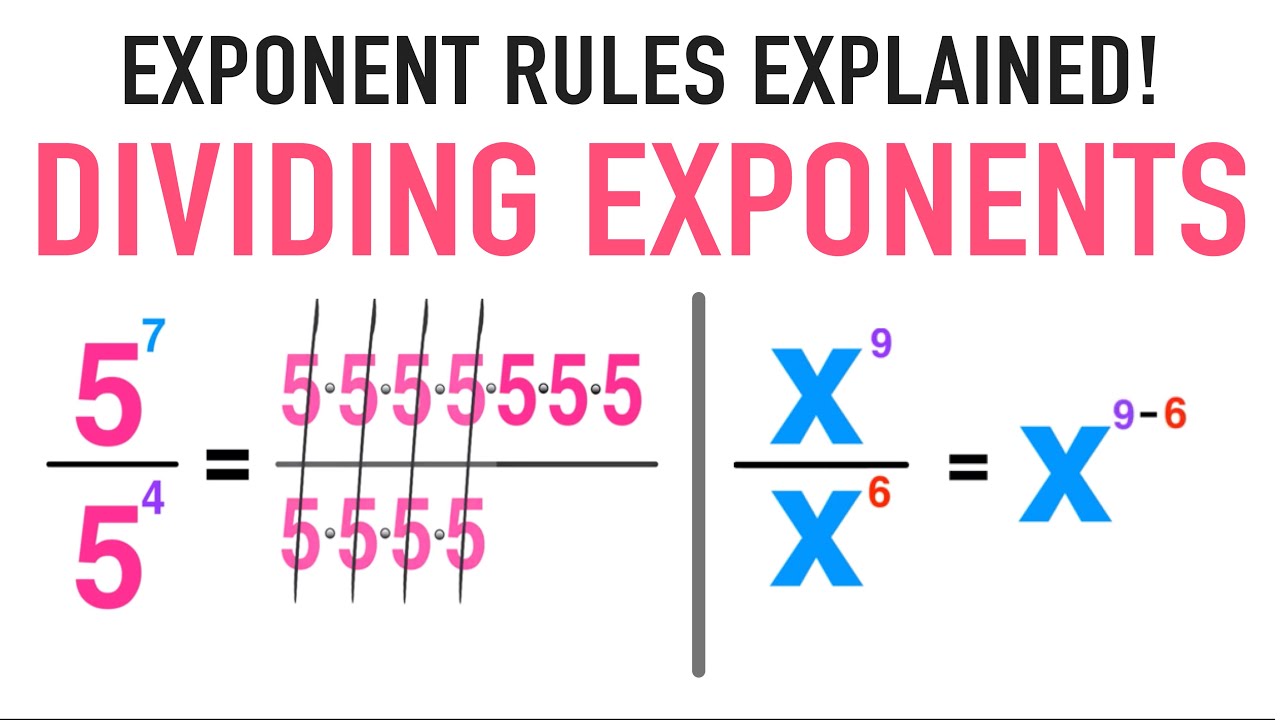
Exponent rules for division. What is an exponent. Power of a Power Rule. 1 Solving-Math-Problems Page Site.
In other words theres another rule that also applies. Yes the rule you described does apply. To divide exponents or powers with the same base subtract the exponents.
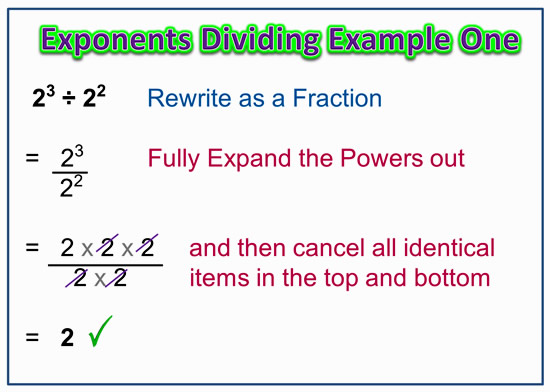
As with many rules related to exponents writing out the exponents as multiplications makes it obvious why the rule is true 3332 333 33 35 33 32 3 333 3 35 12. When a power has an exponent keep the base the same and multiply the exponents. If the denominators exponent is negative you treat it as if it were positive and add it to the numerators exponent.
There are several other rules that go along with the power rule such as the product-to-powers rule and the quotient-to-powers rule. If a 1 button is dark blue you have already 1d it. Adding exponents and subtracting exponents really doesnt involve a rule.
Dividing exponents with different bases When the bases are different and the exponents of a and b are the same we can divide a and b first. 3 3 3 3. If a number is raised to a power add it to another number raised to a power with either a different base or different exponent by calculating the result of the exponent term and then directly adding this to the other.
Rules for multiplying and dividing. To divide exponents that have the same base keep the same base and subtract the power of the denominator from the power of the numerator. Power of a Power Property of Exponent.
The exponent rule for dividing exponential terms together is called the Quotient Rule. A is the base and n is the exponent. A n times.
If exponents have different bases you cannot subtract their powers. 62 4 62 3 62 4. Exponent rules laws of exponent and examples.
Dividing fractions with exponents with same fraction base. When youre subtracting exponents the same conclusion applies. Apply the division rule first and see if negative exponents show up again.
To divide exponents the exponents must have the same base andor the same power. If you like this Page please click that 1 button too. Simply calculate the result if.
The laws of exponents are defined for different types of operations performed on exponents such as addition multiplication and division. Division is the opposite of multiplication so it makes sense that because you add exponents when multiplying numbers with the same base you subtract the exponents when dividing numbers with the same base. The Quotient Rule for Exponents states that when dividing exponential terms together with the same base you keep the base the same and then subtract the exponents.
Abx ax bx. Dividing Fractional Exponents With the Same Base Tackle divisions of two numbers with fractional exponents by subtracting the exponent youre dividing the divisor by the one youre dividing the dividend. 2-3 5-2 5 2 2 3 25 8 3125.
A-n b-m b m a n. Free Exponents Division calculator - Apply exponent rules to divide exponents step-by-step This website uses cookies to ensure you get the best experience. 3 1 3.
When a number is multiplied by itself the exponents are formed. We will now consider combined operations of multiplication and division on numbers in exponent form using all the rules of exponents introduced above. The base a raised to the power of n is equal to the multiplication of a n times.
Review of simplifying expressions with exponents. When the bases and the exponents are different we have to calculate each exponent and then divide. The product of two powers with the same base is equal to that base raised to the sum of the two exponents.
A n b n a b n. What is an exponent. 3 2 3 3 9.
A m n a mn this says that to raise a power to a power you need to multiply the exponents. If thats the case utilize the negative rule of exponent. First of all the two positive numbers the bases have to be the same.
When an exponential expression is raised to a power copy the base which is a nonzero real number then multiply the inner and outer. If the exponential terms have multiple bases then you treat each base like a common term. A x a a 2 a x a x a a 3.
One way to simplify this is to ignore the negative exponents for now. A b n a b m a b n-m. However the answer is not just ab9 because the a is inside the parentheses and so the exponent of 3 outside the parentheses also applies to the a as well as to the b3.
If they are you subtract the exponent in the denominator from the exponent in the numerator. Thus x3 x -1 x4. A n a a.
Dividing fractions with exponents. There is a focus on the reasoning behind the exponent rules as part of this practice so students will be better able to apply these rules with negative exponents. Power Rule Powers to Powers.
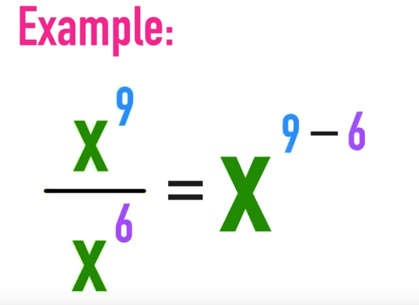
Free Guide Dividing Exponents Explained Mashup Math
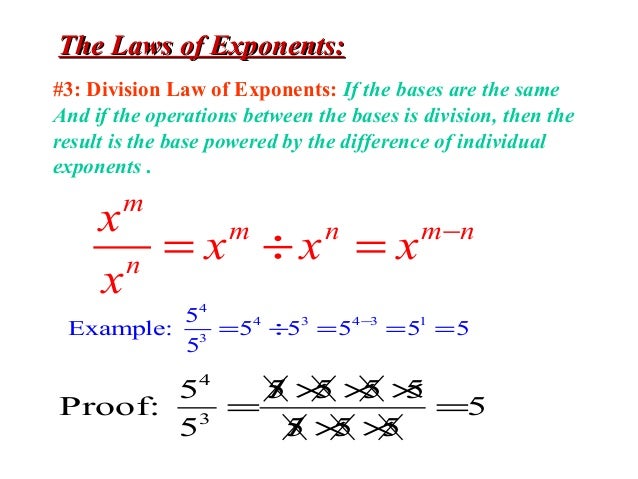
Rules Of Exponents
Mathematics Fundamentals

Exponent Rules Dividing Exponents

Dividing Exponents Passy S World Of Mathematics