After finishing his work in special relativity Einstein spent a decade. Einsteins Theory of Special Relativity - localized behavior of objects in inertial frames of reference generally only relevant at speeds very near the speed of light.
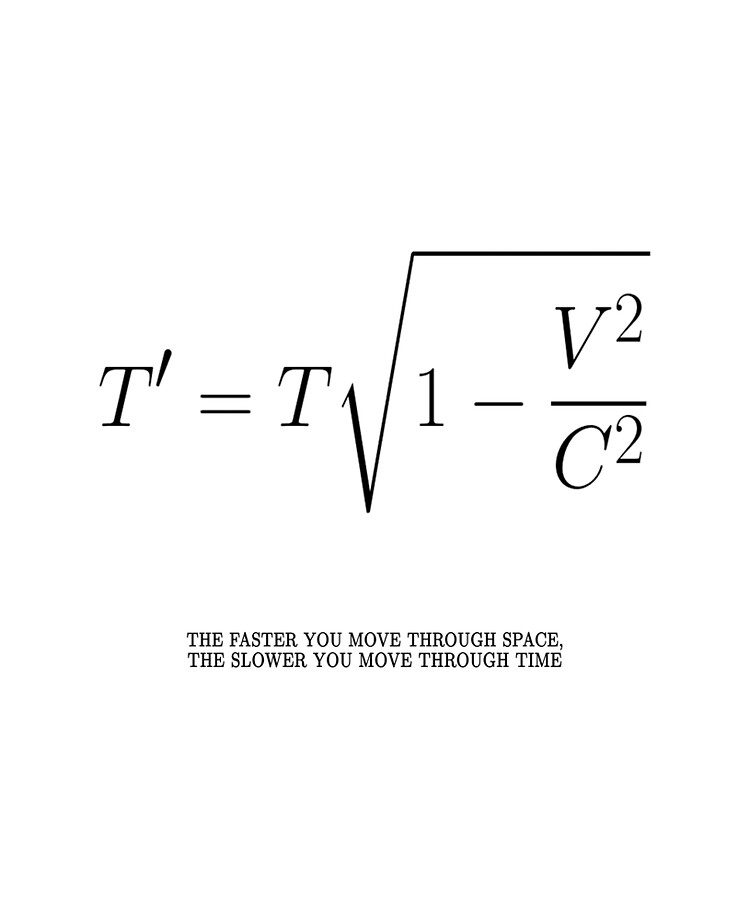
T T Sqrt 1 V 2 C 2 Einstein S Theory Special Relativity Ipad Case Skin By Evelyus Redbubble
In physics the special theory of relativity or special relativity for short is a scientific theory regarding the relationship between space and time.

Einstein's theory of special relativity. Some of these are. But to someone that is moving at a third of the speed of light it will take about 1 hour and 4 minutes. The principle of relativity.
Two events simultaneous for one observer may not be simultaneous for another observer if. Einsteins relativity theory is deceptively simple and consists of just three rules. Relativity is one of the most famous scientific theories of the 20th century but how well does.
Moving clocks are measured to tick more slowly than an observers stationary clock. At 90 percent of the speed of light it takes 2 hours and 18 minutes. Albert Einsteins Theory of Special Relativity The special theory on which the general theory rests applies to all physical phenomena with the exception of gravitation.
Surprising things occur in connection to time in Einsteins theory of special relativity. It was pondering these developments that led Einstein to discover the special theory of relativity in 1905. The theory of special relativity was developed by Albert Einstein in 1905 and it forms part of the basis of modern physics.
Objects are measured to be shortened. Albert Einstein 1879 to 1955 permanently changed the landscape of physics in the early 20th century when he cracked many of the fundamental properties of the Universe. Electrical transmission towers support wires that carry electricity from power plants to homes.
Einsteins theory of relativity includes the interworking of several different concepts which include. His work is also known for its influence on the philosophy of science. In Albert Einstein s original treatment the theory is based on two postulates.
Einsteins special theory of relativity special relativity is all about whats relative and whats absolute about time space and motion. Along with quantum mechanics relativity is central to modern physics. About Press Copyright Contact us Creators Advertise Developers Terms Privacy Policy Safety How YouTube works Test new features Press Copyright Contact us Creators.
The first says every time you measure an objects speed its momentum or how it experiences time will always. The speed of light is the same for all observers regardless of their motion. The principle of the speed of light.
8 Ways You Can See Einsteins Theory of Relativity in Real Life Profound implications. Einsteins theory was based on two key principles. The laws of physics dont change even for objects moving in inertial constant speed.
It was conceived by Einstein in 1905. He published the first part of his theory special relativity in the German physics journal Annalen der Physik in 1905 and completed his theory of general relativity only after. Special relativity part of the wide-ranging physical theory of relativity formed by the German-born physicist Albert Einstein.
The general theory provides the law of gravitation and its relation to the other forces of nature. The theory was the outcome of in Einsteins own reckoning seven and more years of work. He is best known to the general public for his.
14 March 1879 18 April 1955 was a German-born theoretical physicist who developed the theory of relativity one of the two pillars of modern physics alongside quantum mechanics. They are nonetheless correct as numerous physics experiments have shown. The discovery was not momentary.
Albert Einstein ˈ aɪ n s t aɪ n EYEN-styne. Some of Einsteins conclusions are rather surprising. Albert Einsteins theory of relativity is famous for predicting some really weird but true phenomena like astronauts aging slower than people on Earth and solid objects changing their shapes at.
In 1905 Albert Einstein determined that the laws of physics are the same for all non-accelerating observers and that the speed of light in a vacuum was independent of the motion of all observers.