The result is called a confidence interval for the population proportion p. How many adults must be interviewed to estimate the population proportion for a 99 confidence interval with a width of 008.

3 Part 2 The Level Of Confidence C
In real life we usually wont know the population proportion p p p because we wont be able to survey or test every subject within our population.
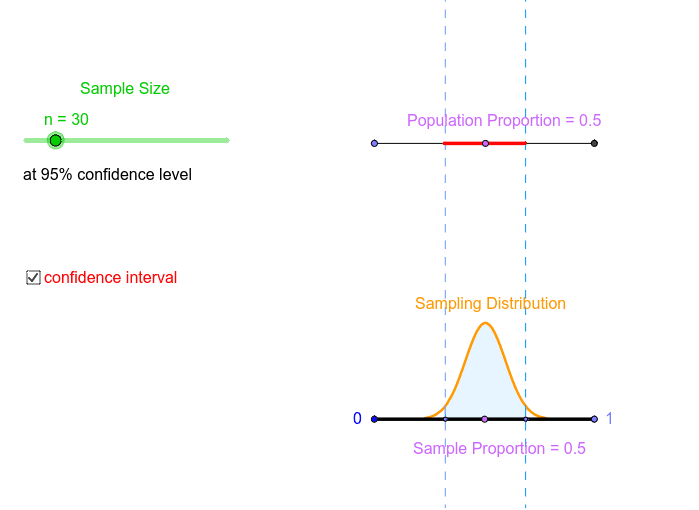
Confidence interval for population proportion. Confidence interval for the population proportion. The confidence interval for a population tells us how confident we can be that a sample proportion represents the actual population proportion. The most commonly used level of Confidence is 95.
The result is the following formula for a confidence interval for a population proportion. P 1 p 2. 3 min read 18 views june 5 2020.
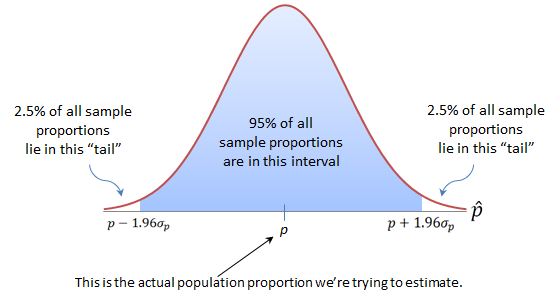
The confidence interval is the range of values that you expect your estimate to fall between a certain percentage of the time if you run your experiment again or re-sample the population in the same way. For the standard normal distribution exactly C percent of the standard normal distribution is between -z and z. This project was supported by the National Center for Advancing Translational Sciences National Institutes of Health through UCSF-CTSI Grant Numbers UL1 TR000004 and UL1 TR001872.
Confidence interval x 1 x 2 - ts p 2 n 1 s p 2 n 2 where. Confidence interval p 1 p 2 - zp 1 1-p 1n 1 p 2 1-p 2n 2 where. Sample 1 size sample 2 size.
We use the following formula to calculate a confidence interval for a population proportion. The z-value that you will use is dependent on the confidence level that you choose. 22 - Confidence Intervals for Population Proportion.
Population Confidence Interval for Proportions Calculation helps you to analyze the statistical probability that a characteristic is likely to occur within the population. 62 Constructing a Confidence Interval for a Population Proportion. What is a Confidence Interval.
The confidence interval for the true binomial population proportion is p EBP p EBP 0810 0874. N 1 n 2. Confidence Interval for a Population Proportion.
A confidence interval is a statistical concept that has to do with an interval that is used for estimation purposes. P - z p 1 - p n 05. Sample 1 proportion sample 2 proportion.
Confidence interval for a proportion This calculator uses JavaScript functions based on code developed by John C. We use the following formula to calculate a confidence interval for a difference between two population proportions. Many things that belong to the problems associated with the mean problem can be borrowed and used when working with proportions.
Confidence Interval for a Difference in Means. The formula for a CI for a population proportion is is the sample proportion n is the sample size and z is the appropriate value from the standard normal distribution for your desired confidence level. The confidence interval for proportions is calculated based on the mean and standard deviation of the sample distribution of a proportion.
Confidence Interval for a Proportion. Here the value of z is determined by our level of confidence C. A confidence interval has the property that we are confident at a certain level of confidence that the corresponding population parameter in this case the population proportion is contained by it.
Confidence Interval p - z p1-p n where. The 95 confidence interval for the true population mean weight of turtles is 29275 30725. We use the following formula to calculate a confidence interval for a difference in population means.
For large random samples a confidence interval for a population proportion is given by sample proportion z sample proportion 1 sample proportion n where z is a multiplier number that comes form the normal curve and determines the level of confidence see Table 91 for some common multiplier numbers. Estimating population proportions can be seen as a particular case of estimating the population mean. The confidence interval for the true binomial population proportion is Interpretation We estimate with 95 confidence that between 81 and 874 of all adult residents of this city have cell phones.
CI for a population proportion is calculated by taking the point estimation and adding or subtracting it to the margin of error. The z-critical value based on the confidence level.
Confidence Interval for a Population Proportion. Confidence interval for a proportion Estimate the proportion with a dichotomous result or finding in a single sample.
Chapter 9
The z-value that you will use is dependent on the confidence level that you choose.
Confidence interval for the population proportion. P - z p 1 - p n 05. 3 min read 18 views june 5 2020. When you see a margin of error in a news report it almost always referring to a 95 confidence interval.
The confidence interval for proportions is calculated based on the mean and standard deviation of the sample distribution of a proportion. A confidence interval is a statistical concept that has to do with an interval that is used for estimation purposes. 22 - Confidence Intervals for Population Proportion.
Population Confidence Interval for Proportions Calculation helps you to analyze the statistical probability that a characteristic is likely to occur within the population. What is a Confidence Interval. Confidence interval for the population proportion.
Confidence Interval for a Proportion. For the standard normal distribution exactly C percent of the standard normal distribution is between -z and z. Estimating population proportions can be seen as a particular case of estimating the population mean.
In real life we usually wont know the population proportion p p p because we wont be able to survey or test every subject within our population. A confidence interval has the property that we are confident at a certain level of confidence that the corresponding population parameter in this case the population proportion is contained by it. The confidence interval for the true binomial population proportion is p EBP p EBP 0810 0874.
A confidence interval CI for a difference in proportions is a range of values that is likely to contain the true difference between two population proportions with a certain level of confidence. This tutorial explains the following. Eqbeginarrayl textConfidence Interval for a Population Proportion beginarrayll n 1100 textSample size Number of trials x 374 text.
This calculator gives both binomial and normal approximation to the proportion. The motivation for creating this confidence interval. CI for a population proportion is calculated by taking the point estimation and adding or subtracting it to the margin of error.
The most commonly used level of Confidence is 95. If they had in fact monitored half the number of customers this interval would increase to between 7077 and 8123. The result is the following formula for a confidence interval for a population proportion.
The formula to create this confidence interval. The 95 confidence interval for this proportion is between 7235 and 7965. We use the following formula to calculate a confidence interval for a population proportion.
But other levels of confidence are possible. Here the value of z is determined by our level of confidence C. 62 Constructing a Confidence Interval for a Population Proportion.
The formula for a CI for a population proportion is is the sample proportion n is the sample size and z is the appropriate value from the standard normal distribution for your desired confidence level. The confidence interval for the true binomial population proportion is Interpretation We estimate with 95 confidence that between 81 and 874 of all adult residents of this city have cell phones. The confidence interval for a population tells us how confident we can be that a sample proportion represents the actual population proportion.
The result is called a confidence interval for the population proportion p. A 95 confidence interval for the percent of all Centre Country households that dont meet the EPA guidelines is given by. Enter parameters in the green cells.
Confidence Interval p - z p1-p n where. Many things that belong to the problems associated with the mean problem can be borrowed and used when working with proportions.