The degree of unsaturation relates the molecular formula of the compound to available possible structures. Individuals now are accustomed to using the net in gadgets to see image and video information for inspiration and according to the name of this article I will discuss about Degree Of Unsaturation Formula.
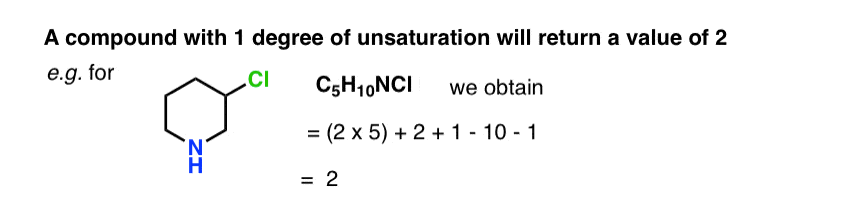
Degrees Of Unsaturation Or Ihd Index Of Hydrogen Deficiency
Of unsaturation 2 2 X C N - H - halogens 2 page 5 of 20.
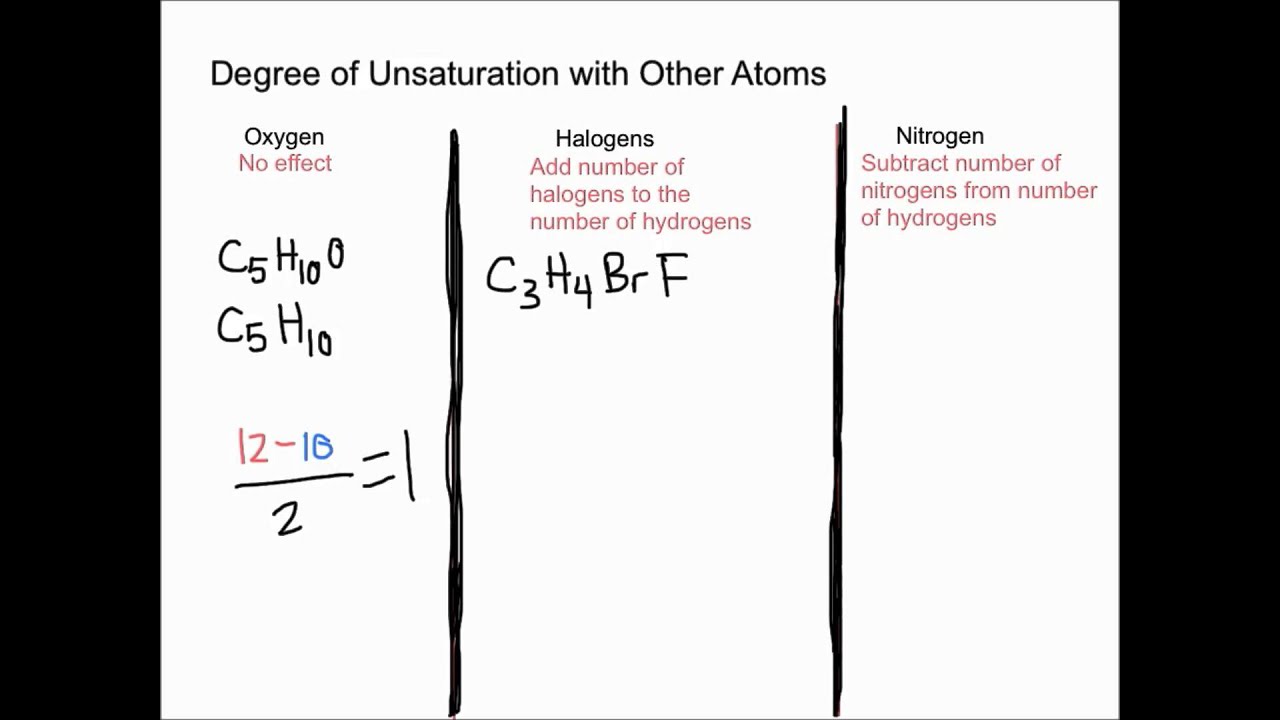
Degree of unsaturation formula. Where n i is the number of atoms with valence v i. In other words both the formula C 8 H 6 F 3 NO 2 and the formula C 8 H 8 have identical numbers of degrees of unsaturation. Degree of unsaturation Total number of rings Total number of double bonds 2 x total number of triple bonds The formula for degree of unsaturation is articulated like this if the molecular formula is given.
Determining degrees of unsaturation from a formula. From the degree of unsaturation the number of multiple bonds and. The most useful and first step that helps us to identify an unknown organic.
Degrees of unsaturation is equal to 2 or half the number of hydrogens the molecule needs to be classified as saturated. Degree of unsaturation formula Indeed recently has been hunted by consumers around us maybe one of you personally. Degree of Unsaturation 2 2 x Carbons Nitrogens - Hydrogens - Halogens2.
Hydrocarbons that contain two double bonds 2 rings or an alkyne a triple bond are said to contain two degrees of unsaturation and have the formula C n H 2n-2 representing a loss of an additional two hydrogens. The formula for degree of unsaturation is. Uses of the degree of unsaturation formula.
That is an atom that has a valence of x contributes a total of x 2 to the degree of unsaturation. The degree of unsaturation designates the number of π bonds or rings that the compound is comprised of. The degree of unsaturation tells you how may rings and multiple bonds are present in a compound provided you know the molecular formula of the compound.
The formula subtracts the number of Xs because a halogen X replaces a hydrogen in a compound. Example of the degree of. The molecular formula is abridged to CnHm and the degree of unsaturation formula is given by.
Hence the DoB formula divides by 2. Knowing the degrees of unsaturation make it easier to figure out the molecular structure and also helps when double-checking the number of pi bonds andor cyclic rings. Any compound C3H6 must have one degree of unsaturation because 2 2x3-621.
As such we know that this formula must correspond to a compound either one double bond or one ring as in propene and cyclopropene shown previously. The molecule contains one nitrogen so you subtract one hydrogen from the molecular formula. For a compound with formula C a H b N c O d X e where X is F Cl Br or I the degree of unsaturation is given by.
The degree of unsaturation formula is also known as index of hydrogen deficiency HD and it is a easy way to calculate the number of multiple bonds or rings in a unknown chemical structure. D e g r e e s o f u n s a t u r a t i o n 2 C 2 N H X 2 Here C. One degree of unsaturation is equivalent to 1 ring or 1 double bond 1 π bond.
Degree of Unsaturation General formula of the degree of unsaturation. Two degrees of unsaturation is equivalent to 2 double bonds 1 ring and 1 double bond 2 rings or 1 triple bond 2 π. The two oxygens in the molecule you ignore.
Degree of unsaturation 12 2 2a - b c - e To calculate the degree of unsaturation enter the values of a b c d and e and press calculate. This organic chemistry video tutorial explains how to calculate the degree of unsaturation or the index of hydrogen deficiency of a molecule given its molecu. Isomer -- molecular formula dictates the degree of unsaturation according to the formula below.
The general formula of alkanes CnH2n2 is used as the standard for determining and comparing different degrees of unsaturation as alkanes are saturated and the simplest in composition among organic molecules. This gives a reduced equation of C 8 H 631 C 8 H 8. The Degree of Unsaturation is defined as the sum of the number of the rings involved plus the total number of multiple bonds present in an organic compound.
The result is then halved and increased by 1. For hydrocarbons that are compounds comprising of only hydrogen and carbon the degree of unsaturation formula is.
What is 1st degree perfect price discrimination. In practice a consumers maximum willingness to pay is difficult to determine.
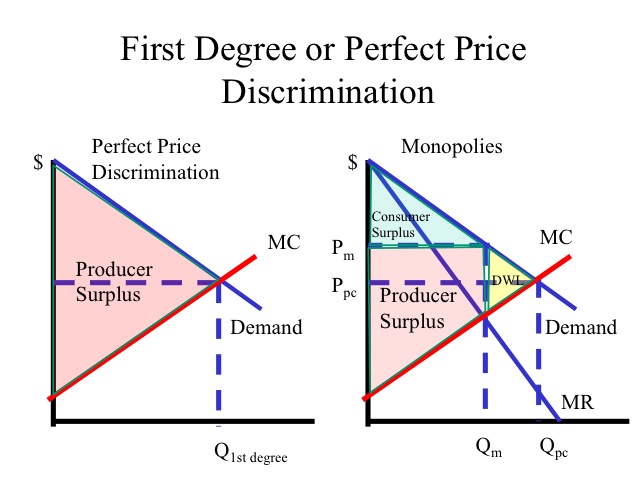
Econ 150 Microeconomics
There will be no consumer surplus.
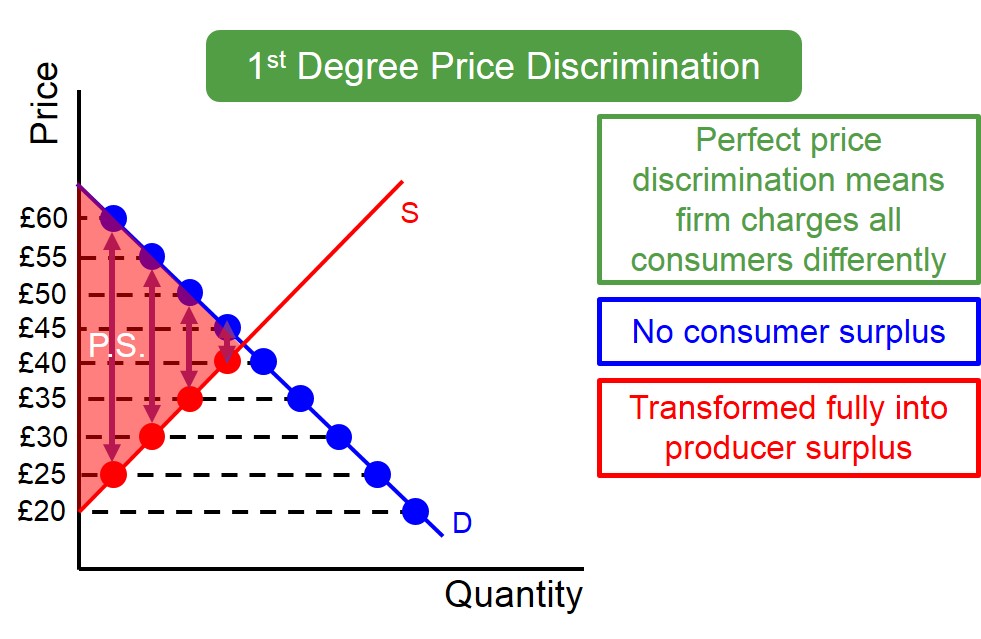
First degree price discrimination. First-degree price discrimination is a type of price discrimination in which producers charge each customer the highest price they are willing and able to pay. If it could it would charge each customer the maximum price that the customer is willing to pay which is known as reservation price. First-degree discrimination or perfect price discrimination occurs when a business charges the maximum possible price for each unit consumed.
Here consumer surplus is entirely captured by the firm. First-degree price discrimination sometimes referred to as perfect price discrimination exists when a firm charges customers a different price for each unit of the good sold everyone pays a different price for the good. This type of pricing strategy takes place when businesses can.
Second degree price discrimination the price of a good or service varies according to the quantity demanded. 20000 and every week reduces the price until the person with the highest bid is reached. In an ideal business world companies would be able to eliminate all consumer surplus through first-degree price discrimination.
Because prices vary among units the firm captures. First degree price discrimination the monopoly seller of a good or service must know the absolute maximum price that every consumer is willing to pay. First-degree price discrimination also called perfect price discrimination or individual targeting is a practice of a single seller offering different prices to different individual buyers for the same good or service.
Price discrimination Price discrimination is the practice of charging a different price for the same good or service. In practice first-degree discrimination is rare. First-degree price discrimination or perfect discrimination is the highest level of price discrimination in which each unit of production is sold at the maximum price that the consumer is willing to pay for that specific unit.
The auction firm starts off at a certain price eg. This involves charging different prices depending upon the choices of consumer. First-degree price discrimination also called perfect price discrimination occurs when a producer charges each consumer his reservation price the maximum amount that he is willing to pay for each unit.
A firm would wish to charge a different price to different customers. There are three types of price discrimination first-degree second-degree and third-degree price discriminationFirst degree First-degree price discrimination alternatively known as perfect price discrimination occurs when a firm charges a different price for every unit. First degree price discrimination is where a firm charges the customer their maximum willingness to pay.
Perfect Price Discrimination is charging whatever the market will bear Sometimes known as optimal pricing with perfect price discrimination the firm separates the market into each individual consumer and charges them the price they are willing and able to pay. This is a type of first-degree price discrimination because in theory it takes all consumer surplus. This is highly effective within firms with high fixed costs who are able to greatly reduce the price for price-sensitive consumers.
First Degree Price Discrimination. The practice of charging each customer his reservation price is called first-degree price discrimination. First-degree price discrimination alternatively known as perfect price discrimination occurs when a firm charges a different price for every unit consumed.
This degree is the ultimate extreme in price discrimination hence its designation as perfect. We also call this perfect price discrimination. Also known as perfect price discrimination first-degree price discrimination involves charging consumers the maximum price that they are willing to pay for a good or service.
This results in consumers receiving no consumer surplus and the firm receiving all gains from the transaction. First-degree price discrimination is a theoretical pricing strategy which involves a firm charging every consumer the maximum price that the individual consumer is willing to pay. Second Degree Price Discrimination.
Different Types of Price Discrimination. First degree Exercising first degree or perfect or primary price discrimination requires the monopoly seller of a good or service to know the absolute maximum price or reservation price that every consumer is willing to pay. First-degree price discrimination or perfect discrimination is the highest level of price discrimination in which each unit of production is sold at the maximum price that the consumer is willing to pay for that specific unit.
The firm is able to charge the maximum possible price for each unit which enables the firm to capture all available consumer surplus for itself. They then get the number plate. This involves charging consumers the maximum price that they are willing to pay.