X Claim you FREE Summer pack for simple steps to get ahead. This makes sense but I had expected that the surface area that is in contact would also play a role.
How Does The Weight Of An Object Affect The Friction It Has On The Surface Gcse Science Marked By Teachers Com
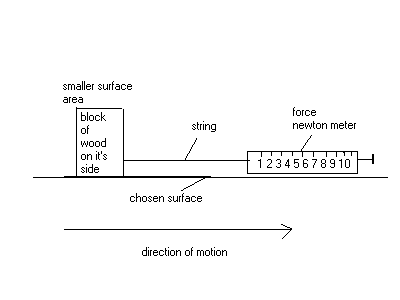
Since pressure equals force divided by the area of contact it works out that the increase in friction generating area is exactly offset by the reduction in pressure.

Friction and surface area. This is not a direct consequence of the fact that the bigger body has higher surface area. Of course this is more a factor with sliding friction which tends to produce heat. No energy wasted on rotating the object then the force required to pull the objects would be the same ie.
Air resistance works with surface area so the more surface area the more air resistance. The book states that the force of friction on an object is the product of two components. This has been observed in practice.
Note that this relationship breaks down when the surface area gets too small since then the coefficient of friction increases because the object may begin to dig into the surface. The force due to friction is generally independent of the contact area between the two surfaces. F f r i c t i o n μ N.
This means that even if you have two heavy objects of the same mass where one is half as long and twice as high as the other one they still experience the same frictional force when you drag them over the ground. The frictional force is constant. To the surface area of the.
μ is the coefficient of friction N is the normal force. For example friction between our shoes and the floor stop us from slipping and friction between tyres and the road stop cars from skidding. The resulting frictional forces then are dependent only on the frictional coefficient of the materials and the FORCE holding.
Friction and Area of Contact Part of the standard model of surface friction is the assumption that the frictional resistance force between two surfaces is independent of the area of contact. Internal friction is the force resisting motion between the elements making up a solid material while it undergoes deformation. Assuming that all the objects have the same mass and that no energy is lost eg.
In this lab students will measure coefficients of friction and show that the frictional force doesnt depend on surface. The crumpled one falls faster because there is less air resistance acting on the paper. 3 The drag coefficient of any object comprises the effects of the two basic contributors to fluid dynamic drag.
Next there will probably be some type of friction laboratory experiment. The greater the surface area the less the increase in temperature The thermal energy is dissipated over a wider area so that μ will tend to change less than in the case less surface area. The force due to friction is generally independent of the contact area between the two surfaces.
The drag coefficient is always associated with a particular surface area. In this worksheet students will consider how surface area affects friction between solid surfaces and in air and water. Friction can be useful.
Although a larger area of contact between two surfaces would create a larger source of frictional forces it also reduces the pressure between the two surfaces for a given force holding them together. There is no dependancy on surface area. The roughness of the polymer surface is shown to be important from a fundamental perspective in Section 1213 Eqn.
1 the force caused by the weight of the object and 2 the types of material that are in contact with each other. Friction is Not Dependent on Surface Area A fascinating property of friction is that it is not dependent on the surface area in contact between two objects. A smooth surface provides greater real contact area between the surfaces resulting in higher friction.
Frictional force does not directly depend on surface area but it does depend on the normal reaction force. The bigger body will have more weight and higher friction will act on it. Basically it holds out against the movement of the object.
Skin friction is a component of drag the force resisting the motion of a fluid across the surface of a body. Friction is a sliding force between an object and a ground that acts oppositely on the motion of an object. Is friction dependent on surface area.
Skin friction and form drag. That formula is as basic as it gets when describing friction. Lubricated friction is a case of fluid friction where a lubricant fluid separates two solid surfaces.
Consider two cubic bodies made of same material. One crumpled and one flat. While exceptions exist the assumption has enough validity to be useful in many circumstances.
Think about when you drop two pieces of paper. Without friction a bicycle wouldnt work this is because there would be no grip on the road surface or pedals and no way to stop the wheels from going around.
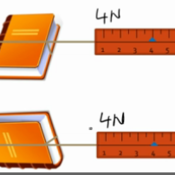
Static Friction Surface Area Tutorial Sophia Learning
Force
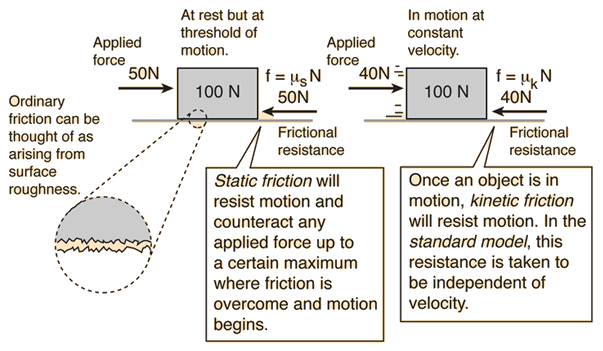
Lab Friction
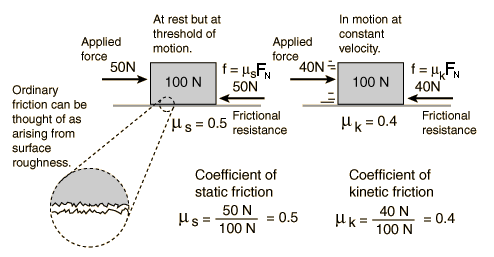

Friction Isn T Always What You Think It Is Wired

History